China Top 10 Dust Collection System Manufacturers
China’s dust-control industry is moving from basic workshop extraction toward cleaner, data-led factory ventilation. A Dust Collection System now supports worker protection, product quality, energy management, and safer production environments. This shift matters in metalworking, woodworking, cement, food processing, chemicals, and battery manufacturing.
Industry reports show a clear commercial opportunity. Grand View Research has reported steady growth in the global industrial air filtration market, driven by stricter emission controls and expanding manufacturing activity. MarketsandMarkets also identifies industrial dust collectors as a growing segment, supported by automation, environmental monitoring, and investment in efficient filtration equipment. These reports provide useful direction, although their market boundaries and forecasting methods differ. The figures should not be treated as absolute truth.
This guide reviews China’s top 10 Dust Collection System manufacturers through practical purchasing criteria. These include filtration efficiency, airflow stability, pressure-drop control, explosion-risk management, noise levels, maintenance access, and after-sales support. Factory experience suggests that a polished brochure is never enough. Inspect filter materials, welding quality, pulse-jet performance, spare-part availability, and actual operating data. Ask for test records.
Relevant references include ISO 16890 for air-filter performance, EN 1822 for high-efficiency filters, and NFPA guidance where combustible dust may exist. Local compliance requirements must also be confirmed before installation. No ranking is flawless. Supplier strength can change with projects, technology, and service capacity. Therefore, this list should support informed comparison, not replace an engineering assessment.
What Is a Dust Collection System?
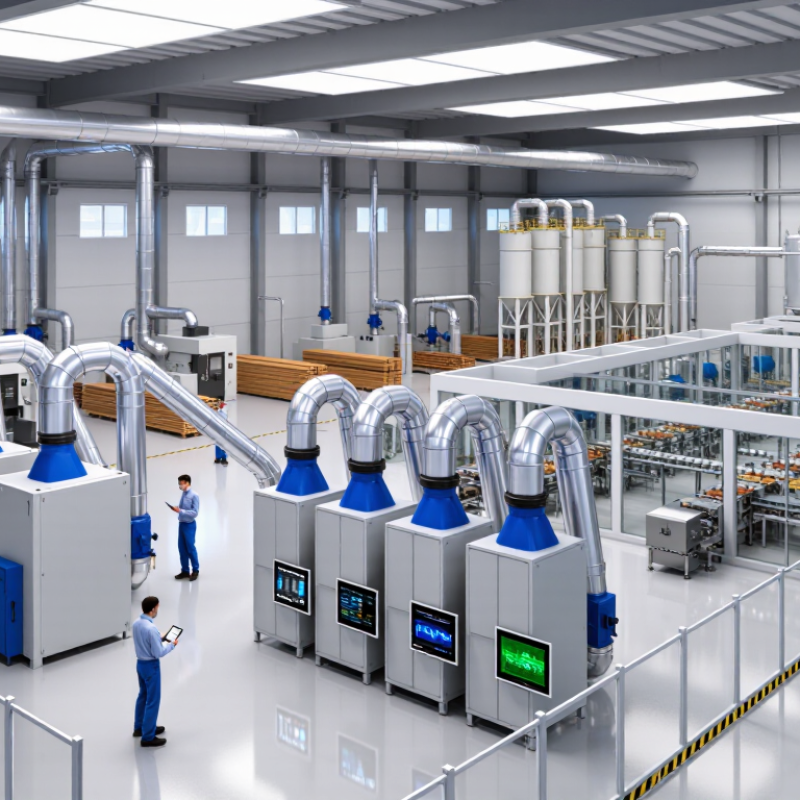
A dust collection system is an engineered air-cleaning arrangement that removes airborne particles from a work area. It usually combines capture hoods, ductwork, a fan, filters, and a dust discharge unit. The hood catches dust near its source, while the fan creates airflow through the system. The filter separates particles from air before cleaner air leaves the equipment. Simple in theory.
In a workshop, dust may rise from cutting, sanding, mixing, or material transfer. A well-designed system captures it close to the emission point, rather than chasing clouds across the room. Duct diameter, airflow speed, pressure loss, and filter area must work together. If the ducts are too narrow, the fan may struggle. If airflow is too weak, fine particles can settle on beams, floors, and machinery. A pressure gauge can help operators notice a loaded filter.
When evaluating Chinese dust collection system manufacturers, buyers should request airflow data, filter specifications, drawings, test records, and maintenance guidance. Experienced suppliers should explain how the equipment suits particle size, moisture, temperature, and operating hours. Safety planning also matters, especially where dust can accumulate or react under certain conditions. Local regulations and site assessments should guide the final design. No system is perfect. Real factories change, and an installation may need adjustment after several weeks of observation.
How China’s Top Dust Collection Manufacturers Are Selected
Selecting China’s top dust collection system manufacturers requires more than comparing catalog prices. MarketsandMarkets reports that the global dust control systems market is projected to grow from about USD 17 billion in 2023 to more than USD 22 billion by 2028. This growth increases supplier choice, but it also makes verification essential. Our screening should examine factory capacity, engineering experience, documented installations, and testing procedures.
Performance comes first. We compare airflow, pressure drop, filter media, dust-loading behavior, and cleaning-cycle stability. The ISO 16890 standard provides a practical reference for particulate air-filter performance, while the WHO 2021 air-quality guidelines recommend annual PM2.5 exposure below 5 μg/m³. These figures do not directly certify a collector, but they clarify why leakage control and final filtration matter. We also inspect weld quality, sealing details, electrical protection, and maintenance access. Small gaps can become expensive problems.
Evidence matters more than attractive claims. We request test records, energy data, spare-parts plans, and customer references from comparable industries. Factory audits should include a live assembly check, not only a showroom visit. Independent reports from the International Energy Agency show that industry remains a major energy consumer, so fan efficiency deserves serious attention. No ranking is flawless. A supplier may perform well in one dusty workshop and struggle with abrasive or humid material. Selection must therefore combine documents, field experience, and technical judgment.
China’s Top 10 Dust Collection System Manufacturers
China’s Top 10 Dust Collection System Manufacturers should be judged by performance, not publicity. A credible ranking examines filtration efficiency, airflow stability, energy use, and after-sales support. In practical factory audits, weld quality and access-panel design often reveal more than brochures. Poorly sealed doors can release fine dust into working areas. That detail matters.
The leading manufacturers usually provide equipment for metalworking, woodworking, chemicals, food processing, and mineral handling. They should offer cartridge collectors, baghouse systems, cyclone pre-separators, and customized ductwork.
Reliable suppliers explain pressure loss clearly and match fan capacity to actual dust loads. They also provide testing records, maintenance schedules, and replacement-filter guidance. No ranking is perfect. Site conditions change, and published specifications may not reflect daily operation.
Tips: Ask for recent project data, airflow measurements, filter-media details, and noise levels. Check whether technicians can inspect the system locally. Request a maintenance demonstration before signing. Do not select equipment from price alone. A cheaper collector may consume more power or require frequent filter replacement. I would also review worker access around hoppers and discharge valves. Small ergonomic problems become expensive after installation. Keep combustible dust risks under professional review, and confirm the design follows applicable safety standards.
Key Technologies and Product Differences Among the Manufacturers
China’s top 10 dust collection system manufacturers often differ less in appearance than in engineering choices. Their main technologies include pulse-jet baghouses, cartridge filters, cyclones, wet scrubbers, and mobile extraction units. Pulse-jet systems clean filters with compressed-air bursts during continuous production. Cartridge designs save floor space, but humid dust can clog them quickly. Cyclones handle coarse particles well, while fine powders usually need secondary filtration.
Product differences also appear in airflow calculations, filter media, and control-system accuracy. Experienced engineers assess dust load, particle size, temperature, humidity, and duct resistance before selecting equipment. Some systems use differential-pressure sensors and variable-frequency drives to reduce fan energy. Others offer grounded structures and certified components for combustible dust applications, following applicable safety standards. These details matter more than polished brochures. However, field data is often incomplete, and a suitable design can still perform poorly after installation. That weakness deserves attention.
Tips: Ask for measured airflow, filter material, pressure-drop curves, noise levels, and maintenance schedules. Request a trial with your actual dust. Check replacement-filter availability and service response time. Do not compare only purchase prices; fan efficiency, compressed-air use, and consumables can sharply change operating costs. Leave room for adjustment.
How to Choose the Right Chinese Dust Collection Supplier
China Top 10 Dust Collection System Manufacturers
Choosing from China’s top ten dust collection system manufacturers requires more than comparing prices. Start with your dust profile: particle size, moisture, temperature, airflow, and operating hours. A supplier should explain filtration efficiency, pressure drop, fan selection, and maintenance intervals in clear technical language. Ask for test records, material specifications, and drawings before approving a quotation.
Factory experience matters. Request videos of production, welding, filter assembly, and quality inspections. Better still, arrange an audit or use an independent inspection service. Speak with recent customers in similar industries, not only selected references. I once trusted an attractive quotation without checking replacement filter costs. That shortcut was wrong. A reliable supplier also provides installation guidance, spare parts, response times, and written warranty terms. Certifications should match the equipment and your market requirements.
Tips: Send the supplier real operating data, not estimates. Ask for a performance test using comparable dust. Confirm the promised airflow at the collector inlet, because catalog figures can mislead. Check whether electrical components suit your site. Discuss dust disposal, noise limits, and cleaning access early. A small pilot unit may reveal problems that drawings hide. Do not choose the cheapest offer automatically. Low initial cost can become expensive through high energy use, frequent filter changes, or weak after-sales support. Be critical. Good suppliers welcome difficult questions.
China Top 10 Dust Collection System Manufacturers - How to Choose the Right Chinese Dust Collection Supplier
| Evaluation Dimension | Recommended Verification Point | Typical Technical Reference | Why It Matters | Priority |
|---|---|---|---|---|
| 1. Dust Characteristics | Request documented information about particle size, moisture, temperature, abrasiveness, toxicity, and explosibility. | Material safety data and process test data should be reviewed before equipment selection. | Dust properties determine filter media, discharge equipment, explosion protection, and maintenance requirements. | Critical |
| 2. Required Airflow | Compare the proposed airflow with the actual number of pickup points, duct length, fittings, and simultaneous operating conditions. | Airflow is normally specified in m³/h or CFM and must be supported by a system pressure-loss calculation. | An undersized system cannot capture contaminants effectively; an oversized system increases energy consumption. | Critical |
| 3. Filtration Technology | Confirm whether the design uses cartridge, baghouse, cyclone, wet scrubber, or a combined configuration. | ISO 16890 is commonly used for classification of general ventilation air filters; application-specific testing may also be required. | The correct technology depends on dust loading, particle size, temperature, humidity, and required outlet concentration. | Critical |
| 4. Emission Performance | Ask for laboratory test results, outlet concentration data, and the measuring method used. | Performance should be stated with units such as mg/m³ and linked to defined operating conditions. | A quoted filtration efficiency without test conditions is not sufficient for comparing suppliers. | Critical |
| 5. Explosion and Fire Protection | Determine whether the dust is combustible and request a documented hazard assessment and protection concept. | Relevant design references may include NFPA combustible-dust guidance, ATEX requirements, or applicable local regulations. | Combustible dust can require bonding, grounding, isolation, venting, suppression, or spark-detection measures. | Critical |
| 6. Fan and Motor Selection | Check fan duty point, motor rating, efficiency, noise level, rotation speed, and variable-frequency-drive compatibility. | The fan should be selected from a performance curve at the specified airflow and total static pressure. | Incorrect fan selection causes unstable airflow, excessive noise, premature wear, or unnecessary operating cost. | High |
| 7. Energy Consumption | Request the estimated operating power at normal production conditions, not only the motor nameplate rating. | Compare kW, operating hours, fan control method, compressed-air demand, and pressure-drop behavior. | Energy and compressed-air costs can exceed the initial price difference over the system life cycle. | High |
| 8. Fabrication and Quality Control | Verify welding procedures, dimensional inspection, coating quality, pressure testing, electrical testing, and final inspection records. | A quality-management certificate such as ISO 9001 can support evaluation but does not replace product-specific inspection. | Consistent fabrication quality improves airtightness, structural reliability, filter life, and installation accuracy. | High |
| 9. Installation and Commissioning | Confirm whether the quotation includes layout drawings, ductwork design, supervision, balancing, performance testing, and operator training. | Commissioning records should include airflow, static pressure, leakage checks, controls, and safety interlock verification. | A reliable system depends on correct installation and balancing, not only on the collector specification. | High |
| 10. After-Sales Support and Spares | Evaluate response time, spare-filter availability, troubleshooting procedures, warranty terms, manuals, and remote-support capability. | The supplier should provide a recommended spare-parts list and a documented preventive-maintenance schedule. | Accessible technical support reduces downtime and helps maintain designed airflow and filtration performance. | High |
Selection note: Supplier quotations should be compared using the same dust properties, airflow, pressure, emission target, safety requirements, delivery scope, and life-cycle cost assumptions.
Related Posts
-
How to Choose the Best Dust Collector for Your Needs?
-
What is the Efficiency of the Best Baghouse Dust Collector in Industrial Applications
-
Top 10 Dust Collector Filter Suppliers Worldwide
-
How to Choose the Right Dust Collector for Your Industrial Needs Based on Air Quality Standards
-
Top 10 Industrial Dust Collector Systems for Global Buyers?
-
Maximize Durability with 5 Essential Tips for Cost Effective Maintenance of Best Industrial Blowers