2026 Top Dust Collection System Manufacturers?
The 2026 Dust Collection System market is becoming more technical, regulated, and application-specific. Manufacturers now compete beyond basic airflow ratings. They must prove filtration efficiency, energy performance, service life, and equipment compatibility. A woodworking shop, metal fabricator, and pharmaceutical plant require very different designs.
Industry research supports this shift. MarketsandMarkets identifies industrial dust control as a growing market, driven by stricter workplace standards and cleaner production requirements. Grand View Research also links dust collector demand with manufacturing expansion, automation, and environmental compliance. These reports provide useful direction, but market estimates differ by scope and methodology. That limitation deserves attention.
Worker protection remains central. The U.S. Occupational Safety and Health Administration limits respirable crystalline silica exposure to 50 micrograms per cubic meter over an eight-hour shift. The U.S. Environmental Protection Agency also emphasizes particulate control through effective capture and filtration practices. These requirements influence system selection, especially where cutting, grinding, sanding, or powder handling occurs.
This guide reviews leading Dust Collection System manufacturers for 2026. It compares engineering depth, filter technology, airflow stability, maintenance access, and after-sales support. Practical details matter. A clogged cartridge can raise pressure drop quickly. An undersized duct can leave visible dust around a machine. A poorly designed spark-control feature can create serious operational concerns.
Not every major brand fits every facility.
The strongest supplier usually combines accurate site assessment with dependable equipment. Pricing alone can mislead. Buyers should examine testing evidence, replacement-filter availability, noise data, warranty terms, and installation experience. Some manufacturer claims also require independent verification. That is where careful comparison becomes valuable.
What Is a Dust Collection System?
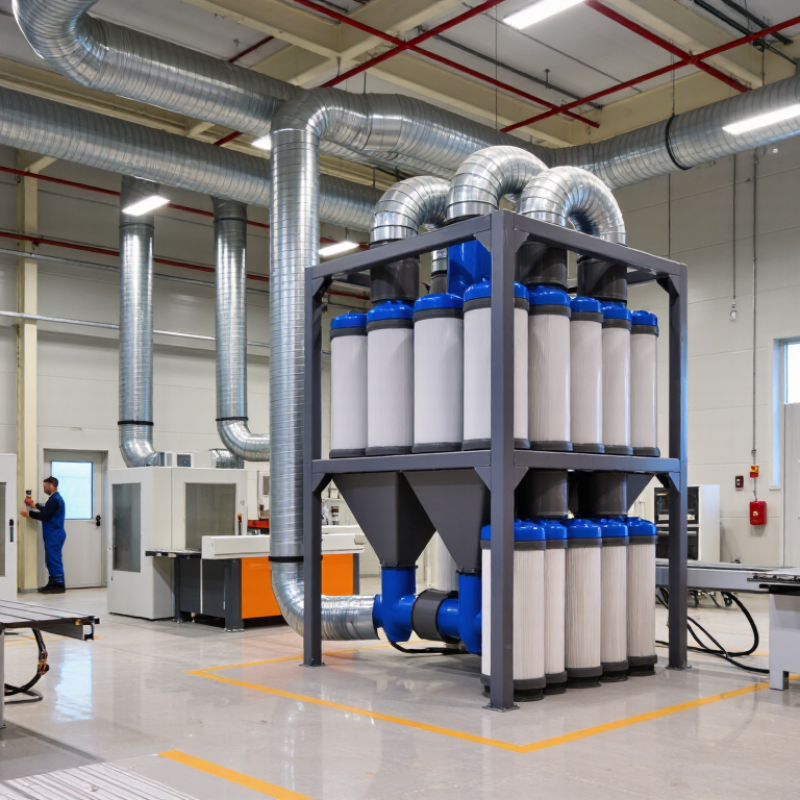
A dust collection system captures airborne particles before they spread through a work area. It usually includes a pickup hood, ductwork, fan, filter, and collection container. The system draws contaminated air from a machine, separates heavier chips, and filters finer dust. It is not decoration. It is part of a controlled workspace.
In a woodworking shop, the pickup point should sit close to the cutting action. A wide-open duct may look impressive, yet poor airflow can leave dust around the blade. Correct duct diameter, smooth bends, and sealed joints help maintain pressure. A cyclone or separator can remove larger particles before they reach the filter. This reduces filter loading and keeps airflow more stable.
Filter performance depends on particle size, airflow volume, and maintenance. A clogged filter can make a strong fan feel weak. That detail matters. Operators should check pressure, empty containers safely, and inspect hoses for cracks. Fine dust may remain suspended even when the floor looks clean. I have seen systems judged by visible chips alone, which is an incomplete test. Noise, energy use, and access for cleaning also deserve attention. The best design is not always the largest one; it is the system matched to each machine, room layout, and working habit. Some layouts still need adjustment after installation. Real conditions expose weaknesses that a specification sheet may miss.
How Dust Collection Systems Capture and Filter Dust
Dust collection systems work by controlling air movement around the dust source. A hood, enclosure, or pickup arm pulls contaminated air into ductwork. High air velocity helps carry particles before they spread across a workshop. Bigger fans are not always better. Poorly sized ducts can reduce capture performance, raise noise, and waste energy.
Inside the collector, airflow slows or changes direction. Heavy chips may fall into a hopper through inertia or gravity. Finer particles move toward filter cartridges, bags, or pleated media. The filter surface holds dust while cleaner air passes through. Pulse-jet cleaning briefly reverses airflow and shakes dust from the media. It helps maintain pressure, but it is not magic. A damaged seal can send fine dust downstream.
Reliable performance depends on details technicians often check during service visits. They measure static pressure, inspect duct joints, and compare airflow at each pickup point. Filters need the correct rating for particle size, temperature, and moisture. A visibly clean filter may still be clogged internally. I have seen operators focus on the collector and ignore an open access door near the machine. That small gap changed the whole system. Good design considers source capture, duct balance, filter loading, discharge handling, and safe maintenance practices. Pressure records can reveal decline earlier than a noisy fan.
| System Type | How Dust Is Captured | Primary Separation or Filter Method | Typical Particle Range | Typical Collection Efficiency | Common Applications | Cleaning or Dust Removal Method | Important Design Consideration |
|---|---|---|---|---|---|---|---|
| Source-Capture Hood | Captures dust close to the generation point before it disperses into the work area. | Local exhaust ventilation connected to a downstream collector. | Depends on the connected filter; commonly used for particles from submicron size to coarse dust. | Depends on the complete system and filter selection. | Welding, grinding, cutting, sanding, laboratory work, and material transfer points. | Handled by the connected cartridge, bag, cyclone, or wet collector. | Hood location, enclosure quality, and transport velocity strongly affect capture performance. |
| Cyclone Pre-Separator | Uses centrifugal force to drive heavier particles toward the collection hopper. | Inertial separation with no disposable filter media. | Most effective for coarse particles, commonly above approximately 10 micrometers. | Often approximately 70%–95% for coarse dust, depending on design and operating conditions. | Wood chips, metal particles, bulk solids, grain, and abrasive process dust. | Manual or automatic emptying of the hopper. | Usually used as a pre-cleaner because fine particles can pass through the cyclone. |
| Cartridge Filter Collector | Contaminated air passes through pleated filter cartridges that retain dust on the media surface. | Pleated cellulose, synthetic, or nanofiber filter media. | Fine dust, commonly from submicron particles to several hundred micrometers. | Often 99% or higher when correctly selected, sealed, and maintained. | Metalworking, pharmaceutical processing, powder handling, composites, and general manufacturing. | Automatic pulse-jet cleaning using short bursts of compressed air. | Filter media must match dust chemistry, temperature, moisture, and combustibility. |
| Baghouse Collector | Dust-laden air flows through fabric bags while dust forms a filter cake on the outer or inner surface. | Woven or felted fabric filter bags. | Fine and coarse industrial dust, including particles below 1 micrometer when properly designed. | Commonly approximately 99%–99.9% for suitable applications and operating conditions. | Cement, asphalt, mineral processing, foundries, woodworking, and bulk-material handling. | Pulse-jet, shaker, or reverse-air cleaning, depending on collector design. | Air-to-cloth ratio, bag temperature rating, moisture control, and dust loading are critical. |
| HEPA Filtration Unit | Fine particles are captured as air passes through dense, high-efficiency filter media. | High-efficiency particulate air media using interception, impaction, and diffusion. | Very fine particles, including aerosols and particles around 0.3 micrometers. | At least 99.97% removal for particles of 0.3 micrometers when tested under the applicable rating method. | Pharmaceutical areas, cleanrooms, healthcare facilities, laboratories, and final-stage air cleaning. | Filter replacement; HEPA elements are generally not pulse-cleaned like industrial bags. | Requires airtight housings, suitable pre-filtration, and controlled pressure-drop monitoring. |
| Wet Scrubber | Dust particles contact liquid droplets or a liquid film and are removed from the air stream. | Water or chemical scrubbing, often combined with droplet separation. | Can handle coarse and fine particles; performance varies by scrubber configuration. | Approximately 95%–99% is achievable for many applications with proper design and operation. | Hot gases, sticky dust, combustible dust, chemical processing, and applications requiring gas cooling. | Liquid circulation, blowdown, sludge removal, and wastewater treatment. | Corrosion, liquid disposal, freezing risk, and pressure drop must be evaluated. |
| Electrostatic Precipitator | Particles are electrically charged and attracted to oppositely charged collection plates. | Electrostatic precipitation with collection electrodes. | Fine particles, including submicron particles, depending on dust resistivity. | Can exceed 99% in suitable applications with correctly controlled operating conditions. | Large-scale combustion, process exhaust, mineral production, and selected industrial gas streams. | Mechanical rapping or vibration dislodges dust into collection hoppers. | Dust resistivity, gas chemistry, temperature, and electrical control stability affect performance. |
| Downdraft or Backdraft Table | Airflow pulls dust downward or backward away from the operator and work surface. | Integrated cartridge, bag, or wet filtration system. | Depends on the installed filter; commonly used for grinding, sanding, and welding particles. | Depends on the filter and enclosure configuration; source capture reduces room-wide dust migration. | Manual grinding, deburring, welding, sanding, and small-part finishing. | Pulse-jet cleaning or filter replacement, depending on the equipment design. | Workpiece size, airflow distribution, operator position, and spark control are important. |
| Central Vacuum Dust Collection System | A network of branch ducts transports dust from multiple pickup points to a central collector. | Usually a cyclone, cartridge, baghouse, or multi-stage filtration arrangement. | Varies from coarse chips to fine process dust according to the selected collector. | Determined by the final filtration stage and system sealing. | Large workshops, woodworking plants, factories, and facilities with multiple machines. | Automatic filter cleaning with centralized hopper or bin discharge. | Duct sizing, balanced airflow, static pressure, explosion protection, and simultaneous-use demand must be engineered. |
Types of Dust Collection Systems and Their Applications
A reliable dust collection system starts with the process, not a sales ranking. In 2026, manufacturers are increasingly judged by airflow control, filter durability, noise management, and service support. A cartridge collector suits fine, dry dust in enclosed workshops. Its compact housing saves floor space. A baghouse collector handles larger air volumes in woodworking and bulk material plants. Cyclone collectors remove heavier particles before filtration. They are useful near saws, shredders, and abrasive operations. Wet scrubbers capture combustible or sticky particles when water treatment is acceptable. Each design has limits. A cyclone alone may not capture fine dust.
Central systems serve several machines through ductwork and automated dampers. Portable units fit repair areas, job sites, or changing production layouts. Source-capture arms work well beside welding benches, mixing stations, and cutting tables.
The collection point matters greatly. Capturing dust close to its release usually needs less energy. Filter selection also depends on particle size, moisture, temperature, and chemical behavior.
Certified airflow testing provides stronger evidence than a brochure claim. Operators should inspect pressure readings, seals, grounding, and disposal containers. Small leaks can defeat expensive equipment.
Tips: Map each emission point before contacting a manufacturer. Record airflow, dust load, operating hours, and available space. Ask for test data using similar material. Do not assume a larger fan means better control. Oversized equipment can waste energy and create unstable airflow. I have seen layouts fail because maintenance access was treated as an afterthought. A practical design leaves room for filter changes, cleaning, and safe inspection.
2026’s Leading Dust Collection System Manufacturers
In 2026, the leading dust collection system manufacturers are defined by measurable performance, not impressive catalogs. Experienced suppliers design systems around particle size, airflow, humidity, and production volume. A metalworking plant may need spark-resistant separation, while a woodworking facility often requires high-volume filtration and easy filter access. Strong manufacturers conduct site surveys before recommending equipment. They also provide airflow calculations, pressure-loss data, and maintenance schedules.
Reliable manufacturers offer modular collectors, cartridge filters, baghouse systems, cyclone separators, and centralized extraction units. Their engineers should explain how each component performs under real operating conditions.
Look for tested filtration efficiency, durable housings, automatic cleaning controls, and clear replacement specifications. Safety features matter too, including grounding, temperature monitoring, and suitable protection against combustible dust hazards. Documentation should be practical, not copied from a generic manual.
After-sales support separates capable manufacturers from ordinary suppliers. Responsive teams can troubleshoot rising pressure readings, leaking duct joints, or filters that load too quickly. Installation training and accessible spare parts reduce downtime. Still, no manufacturer gets every detail right. A technically advanced system can disappoint when ductwork is poorly balanced or operators skip inspections.
This is often missed. Buyers should request references from facilities with similar dust conditions and verify performance after commissioning.
I would also question any supplier promising zero maintenance, because filters collect debris by design and eventually need attention.
How to Compare Manufacturers, Products, and Services
2026 Top Dust Collection System Manufacturers? How to Compare Manufacturers, Products, and Services
Choosing a top dust collection manufacturer requires more than comparing airflow numbers. Start with the dust profile: particle size, moisture, temperature, explosibility, and production volume. A system handling wood dust may fail with sticky chemical powder. Ask manufacturers for tested filtration efficiency, pressure-drop curves, noise data, and energy consumption under realistic loads. Laboratory figures can look excellent. Factory conditions are less polite.
Independent data gives useful benchmarks. The U.S. National Institute for Occupational Safety and Health recommends a respirable crystalline silica exposure limit of 0.05 mg/m³ as a time-weighted average. The Occupational Safety and Health Administration sets an action level of 0.025 mg/m³.
These figures make sensor accuracy, enclosure design, and maintenance access practical purchasing criteria. The U.S. Environmental Protection Agency’s AP-42 emission-factor guidance also shows why process-specific dust data matters. One generic collector cannot fit every application.
Compare the complete service package, not only the equipment price. Request installation records, replacement-filter lead times, remote monitoring details, and documented commissioning procedures. The International Energy Agency reports that industrial motors and related systems represent a major share of global electricity use, so fan efficiency deserves careful review. A lower purchase price may create higher operating costs through excessive pressure loss.
I would also inspect two operating installations, preferably after several months of use. That exposes leaks, difficult filter changes, and optimistic maintenance promises. Even experienced buyers can overweight catalog performance. That is worth questioning.
Related Posts
-
How to Choose the Best Dust Collector for Your Needs?
-
China Top 10 Dust Collection System Manufacturers
-
What is the Efficiency of the Best Baghouse Dust Collector in Industrial Applications
-

The Ultimate Guide to Choosing the Best Sawdust Vacuum System for Your Business Needs
-
Maximize Durability with 5 Essential Tips for Cost Effective Maintenance of Best Industrial Blowers
-
How to Choose the Best Dust Collector Filter Bags